FERN PLANTS GALLERY PAGES Fern Culture with British Ferns and their Allies comprising the Ferns, Club-mosses, Pepperworts and Horsetails by Thomas Moore, F.L.S, F.H.S., Etc. London George Routledge and Sons, Broadway, Ludgate Hill. Hardcover published in 1861 provides details on British Ferns |
TYPE OF FERN TO GROW
Where to see UNITED STATES WALES |
USE OF FERN
Where to see AUSTRALIA CANADA ENGLAND FRANCE GERMANY IRELAND NETHERLANDS
|
SPORE COLOUR BED PICTURES Where to see NEW ZEALAND SCOTLAND UNITED STATES |
A Natural History of Britain's Ferns by Christopher N. Page. Published by William Collins Sons & Co. Ltd in 1988. ISBN 0 00 219382 5 (limpback edition) provides details of Coastal, Man-made Landscapes, Woodland, Wetland, Grassland and Rock Outcrops, Heath and Moorland, Lower Mountain Habitats, Upper Mountain Habitats and Atlantic Fringe Ferns. Tree Ferns by Mark F. Large & John E. Braggins. Published by Timber Press in 2004. ISBN 978-1-60469-176-4 is a scientifically accurate book dealing with Tree Fern species cultivated in the United States and the Pacific, but little known and rare tree ferns are also included. The Observer's Book of Ferns, revised by Francis Rose, previous editions compiled by W.J.Stokoe. Published by Frederick Warne & Co. Ltd in 1965 provides a comprehensive guide to 45 British species of Ferns. It provides details of habitat and how to use those ferns. The Plant Lover's Guide to Ferns by Richard Steffen & Sue Olsen. Published in 2015 by Timber Press, Inc. ISBN 978-1-60469- Success with Indoor Ferns, edited by Lesley Young. Reprinted 1998. ISBN 1 85391 554 8. It details the care of indoor ferns with their position, choice and fern care. |
Where to see UNITED STATES |
|
|
|||
Lithophytes are plants that grow in or on rocks. USE OF FERN as Ferns for Rock Garden in the UK from Ferns for Home and Garden Flowers & Plants. Published by Magna Books in 1995. ISBN 1 85422 888 9. Design and text of plan, planting plan, flowering and colour scheme: Bureau Willemien Dijkshoorn BNT, Amsterdam:-
|
||||||||||
Fern |
Foliage Colour and Some details from The standard Cyclopedia of Horticulture in 3 Volumes by L.H Bailey. Published by The Macmillan Company in 1939 |
Height x Spread in inches (cms) |
Type of Fern to Grow |
Use of Fern |
Comments |
Frond |
Credit |
Form |
||
Cheilanthes tenuifolia (Cheilanthes hispidula , Cheilanthes moluccana , Cheilosoria tenuifolia, Trichomanes tenuifolium ; Acrostichum tenue ; New Zealand, Australia. Fujian, Guangdong, Guangxi, Hainan, S Hunan, Jiangxi, Taiwan, Yunnan [Cambodia, India, Laos, Malaysia, Nepal, Sri Lanka, Thailand, Vietnam; Australia, Oceania (including New Zealand)]. The genus name comes from the Greek cheilos, lip, and anthos, flower, referring to the curled pinnae margins that enclose the sori.
Vernacular names • Narrow-leaved lip fern (En) • Indonesia: paku jepun (Sundanese), paku alus (Moluccas), paku resam lumut (Bangka) • Malaysia: resam lumut, resam padi, paku telur belangkas • Philippines: pakong-roman (Tagalog) • Thailand: chon phee (peninsular) • Vietnam: thần mô lá mảnh. 薄叶碎米蕨 |
The fronds are finely divided, with a lacy appearance and the new fronds are a fresh bright green. Sori confined to distal portion of lobes, interrupted at segment bases. Cheilanthes tenuifolia grows in all the dry parts of New South Wales. It has adapted itself to situations in which it may be absolutely dry for several months during each year, but as soon as rain comes it commences to grow immediately. The fern is not very large. It consists of a subterranean dorsiventral rhizome which occasionally branches and attains a considerable length. Stiff erect fronds rise above the surface of the soil here and there, usually in clumps. This is due to the fact that the fronds grow out from the rhizome much more quickly than the rhizome itself grows. Meanwhile, the fronds along the the older parts of the rhizome die, so that there remains a clump of leaves around the apex. There is a very efficient root system growing out from the rhizome, the main roots branching profusely and giving rise to a very extensive secondary root system. The roots are dark brown, and very thin and wiry. Detrimental to cattle in New South Wales. |
8-16 x |
Cloak, Lip, Hand Ferns and Their Hardy Relatives (Bommeria, Cheilanthes, Doryopteris, Gymnopteris, Hemionitis, Notholaena, Paraceterach, Pellae, Pleurosorus, Quercifilix)
Propagation: By spores sown on fine sandy peat, kept moist and shaded under bell-glass.
A spore of C. tenuifolia germinates readily in culture; rhizoids emerge within 2 weeks after sowing. The prothallus reaches maturity about 6 months after germination of the spore and the gametophyte is cordate, about 1 cm long, glabrous, with a prominent midrib bearing rhizoids and sex organs. The midrib is 6-8 cells thick and the wing cells are uniformly thin-walled. Antheridia mostly globose, appearing superficially on the underside, occasionally on the margins, when the prothallus is about 2 mm wide (after about 40 days) and still one cell thick. The archegonial neck is composed of 6 tiers of cells and curved. Fertilization and formation of sporophytes occurs profusely in culture and generally only a single sporophyte develops per prothallus. The first juvenile leaf is entire, broadly cuneate to spatulate, with a single median vein dichotomizing equally once or twice, hairy especially on the margin. C. tenuifolia grows actively during the rainy season and becomes dormant in the dry season. Spore germination instructions and seeds from Exotic Plants with worldwide shipping (shipping to circling space stations could cost more). |
Suitable for Tall Pot in Conservatory in temperate regions. Stove and Greenhouse Ferns. First introduced late eighteenth century. The pots should be half-filled with crocks to ensure perfect drainage. Slugs are troublesome, unless the pots are stood upon crushed coke, or sifted ashes, over which the slugs do not like to crawl. Add composted bark, charcoal, and humus to the basic mix. Tall narrow pots provide the best drainage for containerized plants. |
Stove Fern. A widely distributed species which grows actively during the monsoonal wet season and becomes dormant in the dry. A difficult subject to grow away from the tropics. Best tried in a partially protected situation outside. This is a fern of open areas in the lowland in Singapore - on bare earthbanks, rock surfaces and even on old walls. C. tenuifolia occurs often on unfertile, dry or humid, rocky ground in open forest areas, on old stone or earthen walls, sometimes amidst alang-alang ( Imperata cylindrica (L.) Raeuschel) or as a weed on ridges in plantations, sometimes gregariously, from sea-level up to 1500 m altitude. It is drought-resistant but also grows well in areas with abundant rainfall. In regions with a pronounced dry season the aboveground parts wither and the plant resumes growth after the first rains. It is often able to regenerate when the grassy vegetation in which it grows is mowed not too close to the ground. On rocks in forests and along stream banks, roadsides, rice fields; 100-1000 m. On rather dry clayey banks of paths in mixed forests at low altitudes in Thailand. |
Cheilanthes tenuifolia - botanical illustrations in Bibliotheca botanica. Stuttgart,E. Schweizerbart [etc.]1886-. biodiversitylibrary.org/page/47220674. From Biodiversity Heritage Library via Wikimedia Commons.
Cheilanthes tenuifolia (Lip Fern, Rock Fern) DSC07747 (09). Photo taken 13 June 2009. By Kwan with his copyright © www. NatureLoveYou.sg
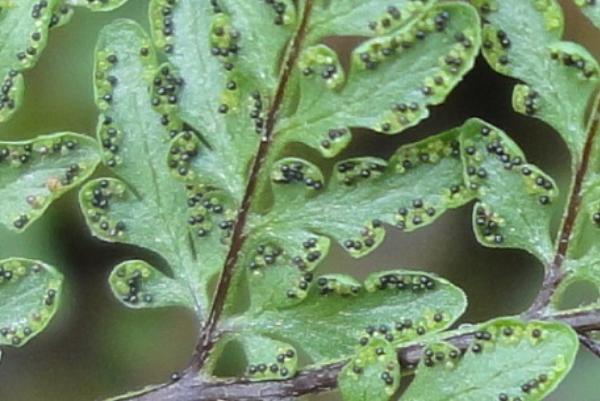
Cheilanthes tenuifolia (Lip Fern, Rock Fern) DSC05720 (11). Spores containing bodies (sporangia) can be seen along the edge of the underside of the leaf (frond). Photo taken 13 June 2009. By Kwan with his copyright © www. NatureLoveYou.sg More photos from New Caledonia. |
||||
Pleurosorus rutifolius (Gymnogramma alpina ; Gymnogramma rutaefolia ; Gymnogramma pozoi var. rutaefolia ; Ceterach rutaefolium ; Grammitis rutaefolia , Asplenium subglandulosum subsp. subglandulosum ) Australia, New Zealand
Temperate-Subtropical Dry |
Rhizome covered with purplish brown scales and old stipe bases. |
2-7 x 4 Small erect tufted fern on a short scaly underground stem (rhizome). |
Cloak, Lip, Hand Ferns and Their Hardy Relatives (Bommeria, Cheilanthes, Doryopteris, Gymnopteris, Hemionitis, Notholaena, Paraceterach, Pellae, Pleurosorus, Quercifilix)
In a terrarium set it up with a stony potting mix (See further details on potting mixes in Chapter 20 of The Encyclopaedia of Ferns An Introduction to Ferns, their Structure, Biology, Economic Importance, Cultivation and Propagation by David L. Jones ISBN 0 88192 054 1) and keep on the dry side (by sparse watering and leaving the lid off for long periods). |
Suitable for Terrarium in temperate regions. Dry well drained soil in rock crevices and gorges associated with woodland. Full sun. Plants will shrivel in extreme dryness and become brown, reviving and regreening after rain. Plants are softer, greener and less hairy in sheltered positions. |
A hardy fern which grows in open situations with its roots in the shelter of rocks, in crevices etc. It is an appealing little fern usually found in colonies. Plants can be grown in a small pot but must not be overwatered and resent stale, humid conditions. Best in a sheltered situation in rocks. Widespread, on hillsides, often growing in the shelter of rocks, chiefly in dry areas and exposed situations in New South Wales, Australia |
|
See photos. It is always found in rock crevices in Canberra, Australia.
Pleuro = side and sorus = heap, referring to the spores along the veins on the underside of the fronds; rutifolius = wrinkled leaves. |
|
||
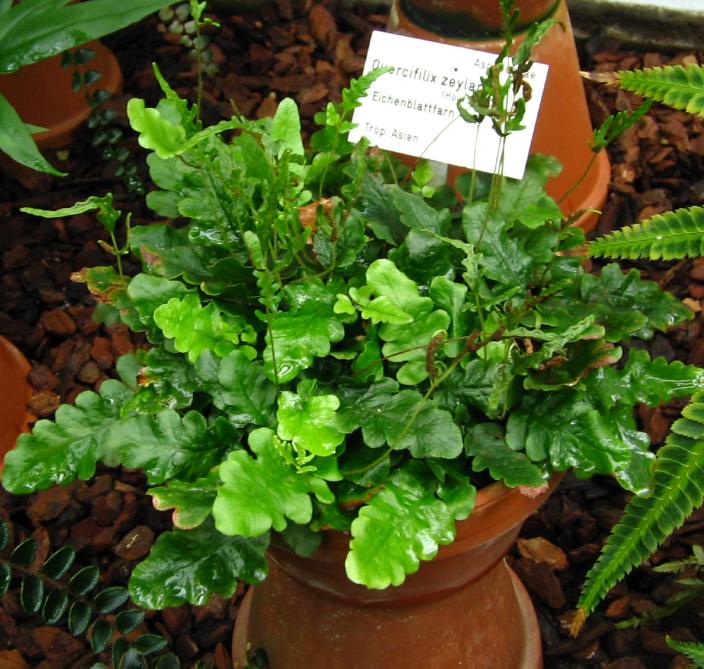
Quercifilix zeylanica (Tectaria zeilanica) Oak Leaf Fern, Oak Leaf Creeper It is native to Sri Lanka, India, and the Indochina region in southern China and Vietnam, and Taiwan. Glasshouse Works only ships within the United States. Black Jungle Exotics sells Exotic Plants, Dart Frogs and Natural Decor for Terrarium and Vivarium Design. |
Terrarium Fern--very slow growing; very shallow wiry roots; must have high levels of humidity and fibrous media. This gem is a collector's excuse to start a Wardian case.
Epihytic or lithophytic ferns grow on trees or rocks in nature. These ferns generally grow very well in soil-less potting mixtures because of the improved aeration and drainage of these media with the following suitable mixes from chapter 20 of The Encyclopaedia of Ferns An Introduction to Ferns, their Structure, Biology, Economic Importance, Cultivation and Propagation by David L. Jones ISBN 0 88192 054 1:- Mix B Mix C Mix D |
40 x 16 |
Cloak, Lip, Hand Ferns and Their Hardy Relatives (Bommeria, Cheilanthes, Doryopteris, Gymnopteris, Hemionitis, Notholaena, Paraceterach, Pellae, Pleurosorus, Quercifilix)
Propagation: See on right. |
Suitable for Terrarium., Wardian Case with flowing waterfall feature within it to provide the humidity and removal of the top for an hour in the morning and evening to prevent the fronds from rotting in temperate regions.
|
A tiny fern with hairy, dimorphic fronds. Can be grown in a small pot of well-drained loamy mixture or in a rock garden in a lightly shaded situation. Has also been grown in a terrarium, however, the fronds may rot in a very humid atmosphere. Minimum winter temperature is 5C (10C from book) with altitude of 0-1000m and creeping habit in the Netherlands. It is a small fern, with erect fertile fronds, and sterile fronds shaped like small oak leaves. |
Tectaria zeylanica syn.Quercifilix zeylanica, collection of Uni Giessen Botanical Garden, Germany. Date: 14 June 2008. By Kembangraps via Wikimedia Commons. Propagation: For those without propagation by spores instructions; the following is suitable: "Keep a close eye upon the fronds, and when the spore cases begin to turn brown remove a frond or portions of it, and wrap them up in white paper, putting them in a closed box for a few days, when an abundance of spores for sowing will be available. Fill some pots with good loam, to within an inch (2.5 cms) of the top, using to drainage, and surface this with some finely broken and dusty crocks or bricks. Give a thorough watering, and when this has soaked away sow the spores as thinly as possible. Stand each pot in a saucer of water, cover it in a case or under a bell-glass where light is available, but where there is no direct sunshine. When the pots get covered with small green scales (prothallica), transplant some of the small tufts with a pointed peg into other pots filled with compost and surfaced with sandy soil. Saucers of water beneath the pots should be used to supply moisture." from Black's Gardening Dictionary. Edited by E.T. Ellis. Published by A & C. Black Ltd in 1928. |
||||
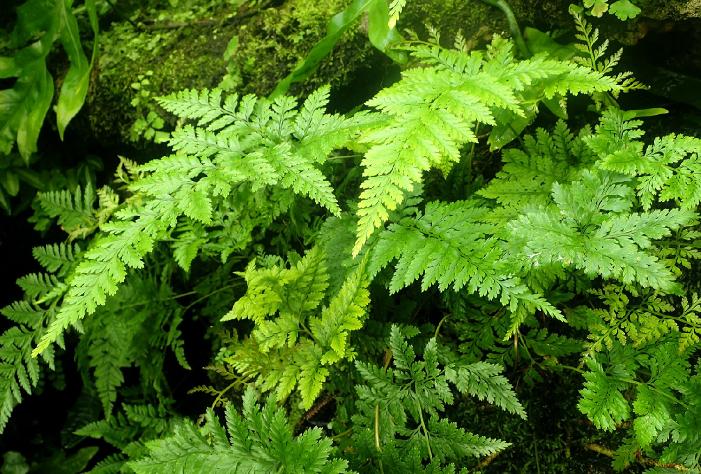
Araiostegia pseudo-cystopteris (Acrophorus pseudo-cystopteris, Araiostegia athamantica, Davallia athamantica, Davallia pseudo-cystopteris, Leucostegia paeudo-cystopteris) Indian Rabbit's Foot Fern USDA Zones 7b to 10b India - A species from the mountains of northern India where it is common on trees and rocks at high elevations. Araiostegia is a genus of twelve epiphytic or terrestrial ferns from tropical Asia belonging to the hares-foot fern family. It has finely pinnate thinly textured fronds arising from long scaly stalks jointed to creeping rhizomes. |
The fronds are finely divided and attractive. The Araiostegia fronds are a beautiful textural addition to the garden and can also be cut and used in floral arrangements. Araiostegia is a hard-to-find fern but one that deserves a spot in every Zone 7 or warmer shade garden in America. |
16-24 x |
Davallia Ferns (Araiostegia, Davallia, Davallodes, Gymno-grammitis, Humata, Leucostegia, Scyphularia, Trogostolon)
Propagation: See instructions on right. |
Suitable for UK in Basket Fern. Woodland.
|
Can be grown as a basket fern or in a pot. The daintily cut, lacy, medium green foliage is attached to a fuzzy rabbit's-foot-type rhizome that lays on the soil surface. Our 15-year-old specimen of Araiostegia pseudocystopteris has formed a 24 inch (60 cm) wide deciduous clump, although planting it on a slope will result in faster growth. It is dormant in the winter. It is hardy enough for North Carolina gardens in America. |
Propagation: For those without propagation by spores instructions; the following is suitable: "Keep a close eye upon the fronds, and when the spore cases begin to turn brown remove a frond or portions of it, and wrap them up in white paper, putting them in a closed box for a few days, when an abundance of spores for sowing will be available. Fill some pots with good loam, to within an inch (2.5 cms) of the top, using to drainage, and surface this with some finely broken and dusty crocks or bricks. Give a thorough watering, and when this has soaked away sow the spores as thinly as possible. Stand each pot in a saucer of water, cover it in a case or under a bell-glass where light is available, but where there is no direct sunshine. When the pots get covered with small green scales (prothallica), transplant some of the small tufts with a pointed peg into other pots filled with compost and surfaced with sandy soil. Saucers of water beneath the pots should be used to supply moisture." from Black's Gardening Dictionary. Edited by E.T. Ellis. Published by A & C. Black Ltd in 1928. "Old plants of Davallia may be cut into a number of smaller ones with a sharp knife. Planted firmly into shallow pans and placed in a temperature of 60-65F (15-18C), they soon develop into symetrical plants. The rhizomes should be firmly fastened to soil by strong copper-wire staples, where they will root in a short time. To gain a large number of small plants, the rhizomes should be detached, cleaned from all soil and roots, laid on sand and thinly covered with moss. Placed in a shaded position in a temperature of 65-70F (18-21C), and kept moderately moist, a number of small plants will develop from the dormant eyes, which may be separately potted as soon as of sufficient size. |
||||
Araiostegia pulchra (Davallia pulchra ; Acrophorus pseudo-cystopteris ; A. pulcher ; Araiostegia athamantica ; A. beddomei ; A. delavayi ; A. imbricata ; A. pseudo-cystopteris ; A. yunnanensis ; Davallia athamantica ; D. beddomei ; D. chaerophylla ; D. imbricata ; D. pseudo-cystopteris ; D. pulchra var. delavayi ; D. pulchra var. pseudo-cystopteris ; D. rigidula ; D. yunnanensis ; Davallodes beddomei ; D. imbricata ; D. pseudo-cystopteris ; D. pulchra ; D. yunnanensis ; Humata chaerophylla ; H. pulchra ; H. yunnanensis ; Leucostegia delavayi ; L. pseudo-cystopteris ; L. pulchra ; L. yunnanensis) USDA Zones 10a-11 India, Sri Lanka - An attractive fern from mountainous regions growing in shady conditions. Guangxi, Guizhou, Sichuan, Xizang, Yunnan [Bhutan, India, Laos, Myanmar, Nepal, Sri Lanka, N Thailand, Vietnam]. Araiostegia is a genus of twelve epiphytic or terrestrial ferns from tropical Asia belonging to the hares-foot fern family. It has finely pinnate thinly textured fronds arising from long scaly stalks jointed to creeping rhizomes. 美小膜盖蕨 mei xiao mo gai jue |
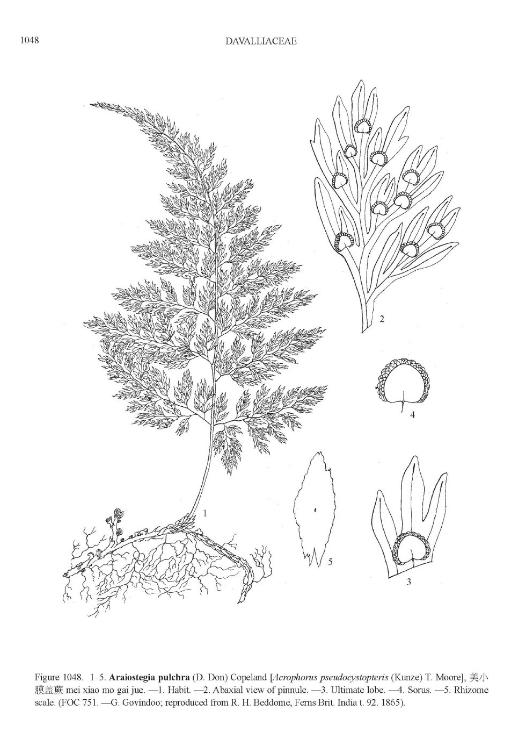
The slender rhizomes are covered with blunt, whitish scales and the fronds tend to be spreading or weeping. Fronds may be deciduous. Sori separate, frequently single on a segment, at forking point of veins or at bending point of a vein; indusium reniform or semicircular, attached at narrow, cordate base only, wider than long, 0.5-0.8 × 0.5-1 mm. The Araiostegia fronds are a beautiful textural addition to the garden and can also be cut and used in floral arrangements. Araiostegia is a hard-to-find fern but one that deserves a spot in every Zone 7 or warmer shade garden in America. |
16-20 x |
Davallia Ferns (Araiostegia, Davallia, Davallodes, Gymno-grammitis, Humata, Leucostegia, Scyphularia, Trogostolon)
Propagation: See instructions on right. |
Suitable for native habitat as a Basket Fern. Woodland. Grow in
|
Easily grown in a pot or basket. Wet forests, epiphytic and epilithic on granite and limestone; 400-3500 m. Forming an impressive species where we gathered this fern on the slopes of Fansipan the highest mountain in the north of Vietnam in 2003. Unfurling from creeping epiphytic rhizomes densely covered with ginger scales, with upright slender scaly stems (stipes) to 50cm long bearing fronds that were loosely triangular in outline to 50cm long and nearly as wide. Which are one of the most delicate looking finely divided species we grow, with the lamina 5 times pinnately divided. Best grown in moist leafmould in full to light shade where the rhizomes can creep along the surface. |
Araiostegia pulchra. Figure 1048. It may be cited as 'eFloras (2008). Published on the Internet http://www.efloras.org [accessed 4 June 2019]' Missouri Botanical Garden, St. Louis, MO & Harvard University Herbaria, Cambridge, MA. Propagation: For those without propagation by spores instructions; the following is suitable: "Keep a close eye upon the fronds, and when the spore cases begin to turn brown remove a frond or portions of it, and wrap them up in white paper, putting them in a closed box for a few days, when an abundance of spores for sowing will be available. Fill some pots with good loam, to within an inch (2.5 cms) of the top, using to drainage, and surface this with some finely broken and dusty crocks or bricks. Give a thorough watering, and when this has soaked away sow the spores as thinly as possible. Stand each pot in a saucer of water, cover it in a case or under a bell-glass where light is available, but where there is no direct sunshine. When the pots get covered with small green scales (prothallica), transplant some of the small tufts with a pointed peg into other pots filled with compost and surfaced with sandy soil. Saucers of water beneath the pots should be used to supply moisture." from Black's Gardening Dictionary. Edited by E.T. Ellis. Published by A & C. Black Ltd in 1928. "Old plants of Davallia may be cut into a number of smaller ones with a sharp knife. Planted firmly into shallow pans and placed in a temperature of 60-65F (15-18C), they soon develop into symetrical plants. The rhizomes should be firmly fastened to soil by strong copper-wire staples, where they will root in a short time. To gain a large number of small plants, the rhizomes should be detached, cleaned from all soil and roots, laid on sand and thinly covered with moss. Placed in a shaded position in a temperature of 65-70F (18-21C), and kept moderately moist, a number of small plants will develop from the dormant eyes, which may be separately potted as soon as of sufficient size. |
||||
Davallia denticulata (Davallia elegans plus others) Rabbit's Foot Fern, Paku Tertutup, Toothed davallia Chinese Name : Hainan [Cambodia, India, Indonesia, Laos, Malaysia, Myanmar, Papua New Guinea, Philippines, Thailand, Vietnam; Africa, Australia, Indian Ocean islands, Pacific islands] A widely distributed species usually found in exposed situations. This fern grows as an epiphyte (epiphyte - A plant growing on another plant but not attached parasitically), also frequently among rocks and often as a terrestrial (terrestrial - growing on the ground) in sandy soil with the rhizomes deeply buried. |
Rootstock clothed with woolly fibers: leaves 9-15 inches (22.5-37.5 cms) wide, with the main rachis slightly winged toward the apex; indusia, several to a segment, with the sharp teeth projecting beyond the cups. Sori separate, several per segment, at forking point of veins. |
24-40 x Grows well under medium light in moist-dry potting mix or uncut moss with good drainage. On dry rocks or on tree trunks in evergreen forests or half-shaded places at altitudes below 200 m, or rarely 500 m in Thailand. It grows on big trees, partially sheltered by the canopy. It occurs locally in Pulau Ubin (Chek Jawa), Pulau Tekong and many other forested and urban sites. It can be propagated by spores or division of the rhizomes in Singapore. |
Davallia Ferns (Araiostegia, Davallia, Davallodes, Gymno-grammitis, Humata, Leucostegia, Scyphularia, Trogostolon)
Propagation: By spores sown on surface of sandy peat in pans under bell-glass in temperature 55-75F (13-24C) at any time; division of rhizomes in February or March. See Growing Davallia Species Indoors in Davallia corniculata description. |
Suitable for House Fern in Hanging Basket within a Conservatory in UK.
Stove evergreen Ferns. |
Stove Evergreen Fern. Plants grow readily in a pot or in the ground but the fronds are deciduous during the winter in its native habitats. Epiphytic on many different species of trees and in different types of forests including mangrove or on solitary trees, epilithic on granite, limestone, or sandstone, terrestrial on different kinds of soil; sea level to 2200 m. Only the typical variety (Davallia denticulata var. denticulata) occurs in China. Often seen as a lithophyte (Lithophytes are plants that grow in or on rocks ) or epiphyte in different forest types. It may lose all its fronds in dry periods. |
|
Davallia, commemorating Edmond Davall, an English-born Swiss botanist from the 18th century; Latin denticulata, finely toothed, referring to the rhizome scales with short spreading curved teeth. |
"Old plants of Davallia may be cut into a number of smaller ones with a sharp knife. Planted firmly into shallow pans and placed in a temperature of 60-65F (15-18C), they soon develop into symetrical plants. The rhizomes should be firmly fastened to soil by strong copper-wire staples, where they will root in a short time. To gain a large number of small plants, the rhizomes should be detached, cleaned from all soil and roots, laid on sand and thinly covered with moss. Placed in a shaded position in a temperature of 65-70F (18-21C), and kept moderately moist, a number of small plants will develop from the dormant eyes, which may be separately potted as soon as of sufficient size. |
||
Davallia divaricata (Araiostegia divaricata; Fujian, Guangdong, Guangxi, Hainan, Taiwan, Yunnan [Cambodia, India, Indonesia, Laos, Malaysia, Myanmar, Papua New Guinea, Philippines, Thailand, Vietnam; Pacific islands (Solomon Islands)]. Siam Greenculture ship plants anywhere, anytime, and can likely send you over 300 species of rare fern and allies - including this one - no matter where in the world you happen to live. |
A very attractive davallia prized for its large, finely-divided, deep green fronds and its rhizomes covered with coarse, dark-coloured, spreading scales. New fronds are red to crimson. Rootstock with linear rusty scales: leaves tri-pinnatifid, sometimes 2' (24 inches, 60 cms) broad, with deltoid segments cut into linear-oblong lobes; sori at some distance from the edge. |
24-48 x |
Davallia Ferns (Araiostegia, Davallia, Davallodes, Gymno-grammitis, Humata, Leucostegia, Scyphularia, Trogostolon)
Propagation: By spores sown on surface of sandy peat in pans under bell-glass in temperature 55-75F (13-24C) at any time; division of rhizomes in February or March. See Growing Davallia Species Indoors in Davallia corniculata description. |
Suitable for House Fern in a Hanging Basket in Conservatory in UK.
Stove and greenhouse evergreen Ferns. |
Stove Evergreen Fern. Makes an excellent basket plant and can be developed into a large specimen. Generally epiphytic, sometimes epilithic on limestone, rarely terrestrial, mostly in dense forests, sometimes on dry places; sea level to 1900 m. On mossy tree trunks or on rocks near streams in light shade or in clearing and on ridge and at low or medium altitudes in Thailand, Laos and Cambodia. A large specie with large and gracefully lacy fronds reaching 30-50 cm. The frond rises from large, blackish rhizome is black covered with short hair when young. Does exceedingly well in fairly dry compost under light shade. Best suit for hanging basket. |
Davallia divaricata. Figure 1055. It may be cited as 'eFloras (2008). Published on the Internet http://www.efloras.org [accessed 12 June 2019]' Missouri Botanical Garden, St. Louis, MO & Harvard University Herbaria, Cambridge, MA. "Old plants of Davallia may be cut into a number of smaller ones with a sharp knife. Planted firmly into shallow pans and placed in a temperature of 60-65F (15-18C), they soon develop into symetrical plants. The rhizomes should be firmly fastened to soil by strong copper-wire staples, where they will root in a short time. To gain a large number of small plants, the rhizomes should be detached, cleaned from all soil and roots, laid on sand and thinly covered with moss. Placed in a shaded position in a temperature of 65-70F (18-21C), and kept moderately moist, a number of small plants will develop from the dormant eyes, which may be separately potted as soon as of sufficient size. |
||||
Davallia pyxidata (Davallia solida var. pyxidata) Zones 8-9 Australia - Endemic and relatively common in coastal eastern Australia, with scattered occurrences in inland forests (Qld, N.S.W.) and an isolated southernmost locality in the Grampian Ranges, Victoria. |
An easily grown fern with woody, erect or spreading rhizomes and leathery, dark green fronds. Juvenile or sterile fronds may be coarsely-divided, while fertile fronds are much finer. Rootstock clothed with pale brown linear scales: leaf-blades tri-quadripinnatifid, 6-9 inches (15-22.5 cms) broad, with oblong segments; sori with a broad space outside, which is extended into a horn-like projection. Can grow in cool areas of Australia. |
12-32 x 40 |
Davallia Ferns (Araiostegia, Davallia, Davallodes, Gymno-grammitis, Humata, Leucostegia, Scyphularia, Trogostolon)
Propagation: By spores sown on surface of sandy peat in pans under bell-glass in temperature 55-75F (13-24C) at any time; division of rhizomes in February or March. See Growing Davallia Species Indoors in Davallia corniculata description. |
Suitable for House Fern in a Trough or in a Hanging Basket within a Heated Greenhouse or in Outdoors Container as bedding plant among rocks in a Rock Garden (bring inside during a very cold winter) within the UK.
Greenhouse evergreen Ferns. |
Greenhouse Evergreen Fern. Can be grown in a pot or basket or among rocks in the garden. A small-medium fern with medium- to long-creeping rhizomes. Best grown under medium-high light in well-drained, moist-dry potting mix or uncut moss. The plants are sometimes used as bedding plants. The stiff, upward-growing rhizomes do not make for a good basket plant. An ideal species for growing in hanging baskets on the veranda in South Africa. It bears attractive, feathery, dark green leaves. Tuck several plants into the perimeter of a coir-lined basket to form a round ball of feathery fronds. Fill the basket with a mixture of compost and acid compost and keep the coir moist. Mist-spray the fronds with water in hot, dry weather. |
It is a variety of fern that occurs in eastern Australia and is usually identified as a lithophyte or epiphyte in or near rainforest areas. However, it may also be seen in a few locations west of the Great Dividing Range. Listed as vulnerable in Victoria, occurring in the Grampians. In Victoria known only from crevices of exposed sandstone cliffs in the Black Range (west of the Grampians). The fronds of the Victorian specimens are less than 20 cm tall (they can reach 60 cm elsewhere). |
Fern West Head underside sori, likely to be Davallia solida var. pyxidata. Ku-ring-gai Chase National Park, Australia.. Date: 29 June 2011. By Poyt448 Peter Woodard via Wikimedia Commons. Hares foot on Hawkesbury Sandstone. West Head, Ku-ring-gai Chase National Park, Australia. Fern is likely to be Davallia solida var. pyxidata. Date: 29 June 2011. By Poyt448 Peter Woodard via Wikimedia Commons.
See other photos. |
"Old plants of Davallia may be cut into a number of smaller ones with a sharp knife. Planted firmly into shallow pans and placed in a temperature of 60-65F (15-18C), they soon develop into symetrical plants. The rhizomes should be firmly fastened to soil by strong copper-wire staples, where they will root in a short time. To gain a large number of small plants, the rhizomes should be detached, cleaned from all soil and roots, laid on sand and thinly covered with moss. Placed in a shaded position in a temperature of 65-70F (18-21C), and kept moderately moist, a number of small plants will develop from the dormant eyes, which may be separately potted as soon as of sufficient size. |
||
|
Tasman's davallia, Three Kings davallia Three Kings Islands and Tasmania (Endemic to New Zealand) Plants grow readily in temperate regions, but do not thrive in hotter climates.
Distinguishing features of |
It is a handsome species with its closely placed, finely-divided leathery fronds. |
8-20 x 20 |
Davallia Ferns (Araiostegia, Davallia, Davallodes, Gymno-grammitis, Humata, Leucostegia, Scyphularia, Trogostolon)
Propagation: By spores sown on surface of sandy peat in pans under bell-glass in temperature 55-75F (13-24C) at any time; division of rhizomes in February or March. See Growing Davallia Species Indoors in Davallia corniculata description. It grows well in dry place and the growth is very slow. It can grow from spores and rooted pieces. Each group of sporangia (a sorus) is inside a distinctive pouch-like covering (indusium) making this an easy fern to identify. |
Suitable for House Fern in Trough or Hanging Basket within Conservatory.
Stove and greenhouse evergreen Ferns. |
Stove Evergreen Fern. A very hardy and cold-resistant fern which can be grown as a ground cover among rocks or in a basket. Davallia tasmanii is primarily a terrestrial species found on rocky banks, rock outcrops and scree slopes in exposed situations or under coastal scrub. Occasionally it is also found as an epiphyte. Grow Davallia tasmanii in well-drained soil or compost. It does well in containers, even when root-bound, and resents root disturbance. It’s ideal for growing as part of a permanent container display in a sunny spot. Frost tender, you may need to move it undercover for winter in the UK. See photos. |
Davallia tasmania, Auckland Winter Garden, Fernery. Date: 22 November 2011. By Andy king50 via Wikimedia Commons. "Old plants of Davallia may be cut into a number of smaller ones with a sharp knife. Planted firmly into shallow pans and placed in a temperature of 60-65F (15-18C), they soon develop into symetrical plants. The rhizomes should be firmly fastened to soil by strong copper-wire staples, where they will root in a short time. To gain a large number of small plants, the rhizomes should be detached, cleaned from all soil and roots, laid on sand and thinly covered with moss. Placed in a shaded position in a temperature of 65-70F (18-21C), and kept moderately moist, a number of small plants will develop from the dormant eyes, which may be separately potted as soon as of sufficient size. |
||||
Davallia tricho-manoides + 骨碎补 gu sui bu Malaysia, New Guinea, Indonesia
Temperate - |
Valued for its neat habit, refreshing lacy fronds and interesting furry rhizomes which wander at will. Plants are deciduous for a short period but new fronds are quickly produced. In the typical form, the rhizome scales are yellowish-brown and in forma barbata they are reddish-brown and the frond margins are less deeply incised. The variety lorrainii has dark-coloured rhizome scales and sparser fronds than other forms. Can grow in cool areas in native districts. A tender, clump-forming, spreading, deciduous fern. Davallia trichomanoides will reach a height of 0.45m and a spread of 0.3m after 5-10 years. |
8-16 x Glass Box Tropicals was created in 2012 in order to provide terrarium hobbyists with an increasingly vast assortment of plants suited for use with poison dart frogs. In addition to growing many of the plants that we offer, we also work with select commercial nurseries in the United States of America and abroad. As Glass Box Tropicals has grown, we have also begun to offer a wide array of other supplies commonly needed when growing plants, building and maintaining terrariums, culturing and caring for microfauna, and caring for poison dart frogs and other terrarium inhabitants. Many of the products we now offer are sourced from all over the world in order to aid you in building your personal rainforest. We are located in Lansing, Michigan and are currently an online store only. |
Davallia Ferns (Araiostegia, Davallia, Davallodes, Gymno-grammitis, Humata, Leucostegia, Scyphularia, Trogostolon)
Propagation: By spores sown on surface of sandy peat in pans under bell-glass in temperature 55-75F (13-24C) at any time; division of rhizomes in February or March. See Growing Davallia Species Indoors in Davallia corniculata description. |
Suitable for House Fern in Trough Garden or Terrarium in the UK. Stove and greenhouse evergreen Ferns. |
Stove Evergreen Fern. A popular fern with fern enthusiasts and general gardeners alike. Excellent for baskets or pots. Epiphytic and epilithic on different kinds of rocks, mostly in wet places, sometimes on dry, exposed places; 100-3500 m. Partial or full shade is required for the growth of it. It can survive in dryness. Davallia trichomanoides is one of the more commonly used ferns in a terrarium. This is due to its ability to be grown both terrestrially and epiphytically. Additionally, the fuzzy brown to black rhizomes also draw many customers to this plant. When grown in a terrarium, this species will generally have fronds about 8” (20 cm) in length and 3-5” (8.75 cm) in width. As it grows, the rhizomes will slowly spread sprouting up new leaves as they go. |
Davallia trichomanoides at Garfield Park Conservatory. Date: 2 September 2016. By Krzysztof Ziarnek, Kenraiz via Wikimedia Commons. |
||||
|
|
|
|
|
|
|
|
|
||
|
|
|
|
|
|
|
|
|
||
|
|
|
|
|
|
|
|
|
||
|
|
|
|
|
|
|
|
|
||
|
|
|
|
|
|
|
|
|
||
|
|
|
|
|
|
|
|
|
||
|
|
|
|
|
|
|
|
|
||
|
|
|
|
|
|
|
|
|
||
|
|
|
|
|
|
|
|
|
||
|
|
|
|
|
|
|
|
|
||
|
|
|
|
|
|
|
|
|
||
|
|
|
|
|
|
|
|
|
||
|
|
|
|
|
|
|
|
|
||
|
|
|
|
|
|
|
|
|
||
|
|
|
|
|
|
|
|
|
||
|
|
|
|
|
|
|
|
|
||
|
|
|
|
|
|
|
|
|
||
|
|
|
|
|
|
|
|
|
||
|
If you grow and sell ferns in any country, please tell me so that I can put them on this website and inform others where they can be bought online via mail-order. If you would provide photos and fern details to be only used by me on this website, they would be gratefully received, since I could assume that the photo was a valid one in regard to its name of fern in its filename to that fern in the photo. |
Site design and content copyright ©January 2009. DISCLAIMER: Links to external sites are provided as a courtesy to visitors. Ivydene Horticultural Services are not responsible for the content and/or quality of external web sites linked from this site. |
Fern Grower's Manual by Barbara Joe Hoshizaki & Robbin C. Moran. Revised and Expanded Edition. Published in 2001 by Timber Press, Inc. Reprinted 2002, 2006. ISBN-13:978-0-88192-495-4. |
|
The remarkable sex life of ferns:-
|
|||||







USE OF FERN WITH PHOTOS
using information from Fern Grower's Manual by Barbara Joe Hoshizaki & Robbin C. Moran and
The Encyclopaedia of Ferns An Introduction to Ferns, their Structure, Biology, Economic Importance, Cultivation and Propagation by David L. Jones ISBN 0 88192 054 1
Outdoor Use in
Northeastern United States Zones 3-6
Southeastern United States Zones 6-8
Southern Florida and Hawaii Zones 10-11
Central United States Zones 3-6
Northwestern United States Zones 5-8 with some Zone 9
Southwestern United States Zones 6-9
Coastal Central and Southern California Zones 9-10
Accent
Aquatic 1, 2
Basket 1,
Ferns for Hanging Baskets 2, 3, 4, 5, 6
Ferns for Hanging Baskets with Pendulous Fronds or weeping Growth Habit 7, 8
Bog or Wet-Soil 1,
Ferns for Wet Soils 2, 3
Border and Foundation 1, 2
Grow in Coastal Region
Cold-hardy Ferns 1, 2, 3, 4, 5, 6
Colour in Fern Fronds 1, 2, 3, 4
Conservatory (Stove House) or Heated Greenhouse 1, 2, 3, 4, 5
Drier Soil 1, 2, 3, 4
Grows on Rock (epilithic) 1, 2
Borne on Leaf (epiphyllous) 1, 2
Grows on another Plant (epiphyte) 1, 2
Evergreen and Deciduous
Fronds in Floral Decorations
Ferns for Acid Soil 1,
Lime-hating (Calcifluges) 2, 3, 4, 5
Ferns for Basic or Limestone Soil 1,
Ferns Found on Limestone or Basic Soils (Calciphiles) 2, 3, 4, 5, 6, 7, 8, 9, 10
Ferns for Ground Cover 1,
Ground Cover Ferns 2, 3, 4, 5
Ferns of the Atlantic Fringe with associated plants (1 - Atlantic Cliff-top Grassland, Ledges and Rough Slopes; 2 - Clay Coasts and Dunes of South-East Ireland; 3 - Limestones of Western Atlantic Coasts; 4 - Hebridean Machair; 5 - Horsetail Flushes, Ditches and Stream Margins; 6 - Water Margin Osmunda Habitats; 7 - Western, Low-lying, Wet, Acid Woodlands; 8 - Western, Oak and Oak-Birch Woodlands and Ravines, in the UK and Ireland)
Ferns in Coastal District with associated plants (Hard Rock Cliffs, Soft Rock Cliffs, Clay Coasts, or Coastal Sand-Dunes in the UK)
Ferns of Grasslands and Rock Outcrops (Grasslands; Rocks, Quarries and Mines in the UK)
Ferns of Heath and Moorland with associated plants (1 - Bracken Heath; 2 - Ferns of Moist Heathland Slopes and Margins of Rills and Streams; 3 - Heathland Horsetails, 4 - Heathland Clubmosses, in the UK)
Ferns of Lower Mountain Habitats with associated plants (1 - Upland Slopes and Screes; 2 - Base-rich, Upland Springs and Flushes; 3 - Base-rich, Upland, Streamside Sands and Gravels; 4 - Juniper Shrub Woodland, in the UK)
Ferns for Man-Made Landscapes with associated plants (South-western Hedgebanks, Hedgerows and Ditches, Walls and Stonework, Water Mills and Wells, Lime Kilns and abandoned Lime-Workings, Pit heaps and Shale Bings, Canals, Railways and Their Environs in the UK)
Ferns of Upper Mountain Habitats with associated plants (1 - High Mountain, Basic Cliffs and Ledges; 2 - High, Cliff Gullies; 3 - High Mountain Corries, Snow Patches and Fern beds; 4 - Ridges, Plateaux and High Summits, in the UK)
Ferns for Wetlands with associated plants (1- Ponds, Flooded Mineral Workings and Wet Heathland Hollows; 2 - Lakes and Reservoirs; 3 - Fens; 4 - Ferns of the Norfolk Broads' Fens; 5 - Willow Epiphytes in the UK)
Ferns in Woodland with associated plants (1 - Dry, Lowland, Deciduous Woodland; 2 - Inland, Limestone, Valley Woodland; 3 - Base-rich Clay, Valley Woodland; 4 - Basic, Spring-fed Woodland; 5 - Ravine Woodland on Mixed Rock-types; 6 - Native Pine Forest in the UK)
Ferns in Hedges or Hedgebanks
Outdoor Containers 1, 2, 3, 4, 5, 6, 7
Rapidly Growing Fern 1, 2
Resurrection Fern
Rock Garden and Wall Ferns 1, 2, 3, 4, 5
Shade Tolerant 1, 2, 3, 4
Slowly Growing Fern
Sun Tolerant 1, 2, 3, 4
House Fern in Trough Garden 1,
Fern Suitable for
Indoor Decoration 2, 3, 4, 5, 6
House Fern in Terrarium, Wardian Case or
Bottle Garden 1,
Ferns suitable for Terrariums, Wardian Cases 2, 3, 4,
5, 6
Grow in Woodlands 1, 2, 3, 4
TYPE OF FERN TO GROW WITH PHOTOS
using information from
Fern Grower's Manual by Barbara Joe Hoshizaki & Robbin C. Moran and
The Encyclopaedia of Ferns An Introduction to Ferns, their Structure, Biology, Economic Importance, Cultivation and Propagation by David L. Jones ISBN 0 88192 054 1
Aquatic Ferns (Azolla, Ceratopteris, Marsilea, Pilularia, Regnellidium, Salvinia)
Boston ferns (Nephrolepis exaltata), Fishbone ferns (Nephrolepis cordifolia), Lace ferns and Sword ferns
Cloak, Lip, Hand Ferns and their Hardy Relatives (Bommeria, Cheilanthes, Doryopteris, Gymnopteris, Hemionitis, Notholaena, Paraceterach, Pellae, Pleurosorus, Quercifilix) 1,
2, 3
Davallia Ferns (Araiostegia, Davallia, Davallodes, Gymno-grammitis, Humata, Leucostegia, Scyphularia, Trogostolon) 1, 2
Fern Allies (Psilotums or Whisk Ferns, Lycopodiums or Ground Pines, Selaginellas or Spike Mosses, and Equisetums, Horsetails or Scouring Rushes) 1, 2
Filmy and Crepe Ferns (Hymenophyllum, Trichomanes, Leptopteris) 1, 2
Lacy Ground Ferns (Culcita, Dennstaedtia, Histiopteris, Hypolepis, Leptolepia, Microlepia, Paesia, Pteridium) 1, 2
Lady Ferns and Their Allies (Allantodia, Athyrium, Diplazium, Lunathyrium, Pseudo-cystopteris, Callipteris, Cornopteris, Cystopteris) 1, 2
Maidenhair Ferns (Adiantum) 1, 2
Miscellaneous Ferns (Acrostichum, Actiniopteris, Anemia, Anogramma, Anopteris, Blotiella, Bolbitis, Christella, Coniogramma, Cryptogramma, Ctenitis, Cyclosorus, Didymochlaena, Dipteris, Elaphoglossum, Equisetum, Gymnocarpium, Llavea, Lonchitis, Lygodium, Macrothelypteris, Oeontrichia, Oleandra, Onoclea, Onychium, Oreopteris, Parathelypteris, Phegopteris, Photinopteris, Pityrogramma, Pneumatopteris, Psilotum, Stenochlaena, Thelypteris, Vittaria)
1, 2, 3, 4 including Fern Allies of Equisetum and Psilotum or Whisk Ferns
Polypodium Ferns and Relatives (Anarthropteris, Belvisia, Campyloneurum, Colysis, Crypsinus, Dictymia, Gonphlebium, Lecanopteris, Lemmaphyllum, Lexogramme, Microgramma, Microsorum, Niphidium, Phlebodium, Phymatosurus, Pleopeltis, Polypodium, Pyrrosia, Selliguea) 1, 2, 3
Primitive Ferns and Fern Oddities (Angiopteris, Botrychium, Christensenia, Danaea, Helminthostachys, Marattia, Ophioglossum, Osmunda and Todea)
Scrambling, Umbrella, Coral and Pouch Ferns (Dicranopteris, Diploptergium, Gleichenia, Sticherus)
Shield, Buckler, Holly Ferns and their Relatives (Arachniodes, Cyrtomium, Dryopteris, Lastreopsis, Matteuccia, Polystichum, Rumohra, Tectaria and Woodsia) 1, 2, 3, 4
Spleenworts Ferns (Asplenium) 1, 2, 3
Staghorns, Elkhorns and other large epiphytes (Aglaomorpha, Drynaria, Merinthosorus, Platycerium, Pseudodrynaria) 1, 2
Fern Allies - Tassel Ferns and Clubmosses (Lycopodium)
The Brakes (Pteris) 1, 2
Tree Ferns (Cibotium, Cnemidaria, Cyathea, Dicksonia, Nephelea and Trichipteris) 1, 2
Water, Hard, Rasp and Chain Ferns (Blechnum, Doodia, Woodwardia, Sadleria) 1, 2
Xerophytic Ferns (Actinopteris, Astrolepis, Cheilanthes, Doryopteris, Notholaena, Pellaea, Pityrogramma) 1, 2
Topic
|
|
|
|
STAGE 4C CULTIVATION, POSITION, USE GALLERY
Cultivation Requirements of Plant |
|
Outdoor / Garden Cultivation |
|
Indoor / House Cultivation |
|
Cool Greenhouse (and Alpine House) Cultivation with artificial heating in the Winter |
|
Conservatory Cultivation with heating throughout the year |
|
Stovehouse Cultivation with heating throughout the year for Tropical Plants |
|
|
|
Sun Aspect |
|
|
|
Soil Type |
|
|
|
Soil Moisture |
|
|
|
Position for Plant |
|
Ground Cover 0-24 inches (0-60 cms) |
|
Ground Cover 24-72 inches (60-180 cms) |
|
Ground Cover Over 72 inches (180 cms) |
|
1, 2, |
|
|
|
Use of Plant |
|
|
|
STAGE 4D Plant Foliage |
|
|
|
Flower Shape |
|
Number of Flower Petals |
|
|
|
Flower Shape - Simple |
|
|
|
|
|
|
Flower Shape - Elaborated |
|
|
|
Natural Arrangements |
|
|
|
STAGE 4D |
|
|
|
|
|
Form |
|
|
|
|
|
STAGE 1
Fragrant Plants adds the use of another of your 5 senses in your garden:- |
|
|
|
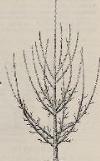
STAGE 2 Fan-trained Shape From Rhododendrons, boxwood, azaleas, clematis, novelties, bay trees, hardy plants, evergreens : novelties bulbs, cannas novelties, palms, araucarias, ferns, vines, orchids, flowering shrubs, ornamental grasses and trees book, via Wikimedia Commons |
|
Ramblers Scramblers & Twiners by Michael Jefferson-Brown (ISBN 0 - 7153 - 0942 - 0) describes how to choose, plant and nurture over 500 high-performance climbing plants and wall shrubs, so that more can be made of your garden if you think not just laterally on the ground but use the vertical support structures including the house as well. The Gardener's Illustrated Encyclopedia of Climbers & Wall Shrubs - A Guide to more than 2000 varieties including Roses, Clematis and Fruit Trees by Brian Davis. (ISBN 0-670-82929-3) provides the lists for 'Choosing the right Shrub or Climber' together with Average Height and Spread after 5 years, 10 years and 20 years. |
|
|
|
STAGE 2
|
|
|
|
STAGE 4D Trees and Shrubs suitable for Clay Soils (neutral to slightly acid) Trees and Shrubs suitable for Dry Acid Soils Trees and Shrubs suitable for Shallow Soil over Chalk Trees and Shrubs tolerant of both extreme Acidity and Alkalinity Trees and Shrubs suitable for Damp Sites Trees and Shrubs suitable for Industrial Areas Trees and Shrubs suitable for Cold Exposed Areas Trees and Shrubs suitable for Seaside Areas Shrubs suitable for Heavy Shade Shrubs and Climbers suitable for NORTH- and EAST-facing Walls Shrubs suitable for Ground Cover Trees and Shrubs of Upright or Fastigiate Habit Trees and Shrubs with Ornamental Bark or Twigs Trees and Shrubs with Bold Foliage Trees and Shrubs for Autumn Colour Trees and Shrubs with Red or Purple Foliage Trees and Shrubs with Golden or Yellow Foliage Trees and Shrubs with Grey or Silver Foliage Trees and Shrubs with Variegated Foliage Trees and Shrubs bearing Ornamental Fruit Trees and Shrubs with Fragrant or Scented Flowers Trees and Shrubs with Aromatic Foliage Flowering Trees and Shrubs for Every Month:- |
|


.jpg)


.jpg?uselang=en-gb)
Use of Fern
|
Use of Fern
See
If you grow and sell ferns, please tell me so that I can put them on this website and inform others where they can be bought online via mail-order. The remarkable sex life of ferns:-
|
||||||||||||||||||||||||||||||||||||||||||||||||||||||||||||||||||||||||||||||||||||||||||||||||||||||||||||||||||||||||||||||||||||||||||||||||||||||||||||||||||||||||||||||||||||||||||||||||||||||||||||||||||||||||||||||||||||||||||||||||||||||||||||||||||||||||||||||||||||||||||||||||||||||||||||||||||||||||||||||||||||||||||||||||||||||||||||||||||||||||||||||||||||||||||||||||||||||||||||||||||||||||||||||||||||||||||||||||||||||||||||||||||||||||||||||||||||||||||||||||||||||||||||||||||||||||||||||||||||||||||||||||||||||||||||||||||||||||||||||||||||||||||||||||||||||||||||||||||||||||||||||||||||||||||||||||||||||||||||||||||||||||||||||||||||||||||||||||||||||||||||||||||||||||||||||||||||||||||||||||||||||||||||||||||||||||||||||||||||||||||||||||||||||||||||||||||||||||||||||||||||||||||||||||||||||||||||||||||||||||||||||||||||||||||||||||||||||||||||||||||||||||||||||||||||||||||||||||||||||||||||||||||||||||||||||||||||||||||||||||||||||||||||||||||||||||||||||||||||||
|
|
||||||||||||||||||||||||||||||||||||||||||||||||||||||||||||||||||||||||||||||||||||||||||||||||||||||||||||||||||||||||||||||||||||||||||||||||||||||||||||||||||||||||||||||||||||||||||||||||||||||||||||||||||||||||||||||||||||||||||||||||||||||||||||||||||||||||||||||||||||||||||||||||||||||||||||||||||||||||||||||||||||||||||||||||||||||||||||||||||||||||||||||||||||||||||||||||||||||||||||||||||||||||||||||||||||||||||||||||||||||||||||||||||||||||||||||||||||||||||||||||||||||||||||||||||||||||||||||||||||||||||||||||||||||||||||||||||||||||||||||||||||||||||||||||||||||||||||||||||||||||||||||||||||||||||||||||||||||||||||||||||||||||||||||||||||||||||||||||||||||||||||||||||||||||||||||||||||||||||||||||||||||||||||||||||||||||||||||||||||||||||||||||||||||||||||||||||||||||||||||||||||||||||||||||||||||||||||||||||||||||||||||||||||||||||||||||||||||||||||||||||||||||||||||||||||||||||||||||||||||||||||||||||||||||||||||||||||||||||||||||||||||||||||||||||||||||||||||||||||||
Companion Plants
A question Shady Plants get asked many times is what flowering plants are suited for growing with ferns. There are a few choice plants, with elegant flowers with subtle shades that compliment ferns and grow well in shade. Here is a collection of plants that, in my opinion, go very well with ferns:-
and
Ferns of the Atlantic Fringe with associated plants (1 - Atlantic Cliff-top Grassland, Ledges and Rough Slopes; 2 - Clay Coasts and Dunes of South-East Ireland; 3 - Limestones of Western Atlantic Coasts; 4 - Hebridean Machair; 5 - Horsetail Flushes, Ditches and Stream Margins; 6 - Water Margin Osmunda Habitats; 7 - Western, Low-lying, Wet, Acid Woodlands; 8 - Western, Oak and Oak-Birch Woodlands and Ravines, in the UK and Ireland)
Ferns in Coastal District with associated plants (Hard Rock Cliffs, Soft Rock Cliffs, Clay Coasts, or Coastal Sand-Dunes in the UK)
Ferns of Grasslands and Rock Outcrops (Grasslands; Rocks, Quarries and Mines in the UK)
Ferns of Heath and Moorland with associated plants (1 - Bracken Heath; 2 - Ferns of Moist Heathland Slopes and Margins of Rills and Streams; 3 - Heathland Horsetails, 4 - Heathland Clubmosses, in the UK)
Ferns of Lower Mountain Habitats with associated plants (1 - Upland Slopes and Screes; 2 - Base-rich, Upland Springs and Flushes; 3 - Base-rich, Upland, Streamside Sands and Gravels; 4 - Juniper Shrub Woodland, in the UK)
Ferns for Man-Made Landscapes with associated plants (South-western Hedgebanks, Hedgerows and Ditches, Walls and Stonework, Water Mills and Wells, Lime Kilns and abandoned Lime-Workings, Pit heaps and Shale Bings, Canals, Railways and Their Environs in the UK)
Ferns of Upper Mountain Habitats with associated plants (1 - High Mountain, Basic Cliffs and Ledges; 2 - High, Cliff Gullies; 3 - High Mountain Corries, Snow Patches and Fern beds; 4 - Ridges, Plateaux and High Summits, in the UK)
Ferns for Wetlands with associated plants (1- Ponds, Flooded Mineral Workings and Wet Heathland Hollows; 2 - Lakes and Reservoirs; 3 - Fens; 4 - Ferns of the Norfolk Broads' Fens; 5 - Willow Epiphytes in the UK)
Ferns in Woodland with associated plants (1 - Dry, Lowland, Deciduous Woodland; 2 - Inland, Limestone, Valley Woodland; 3 - Base-rich Clay, Valley Woodland; 4 - Basic, Spring-fed Woodland; 5 - Ravine Woodland on Mixed Rock-types; 6 - Native Pine Forest in the UK)