Ivydene Gardens Library Catalogue: Practical Projects Books - H-S |
||||
Each entry, where possible, has an International Standard Book Number (ISBN) to assist you in locating a copy. In order to assist the design process for a garden, the Library has been split into the following order of abstraction:-
The Reference Library and the Practical Projects categories will assist with construction. Private garden maintenance can then be assisted by the following:-
Please note that entries in the library pages in red text indicate books that Chris Garnons-Williams has found to be more useful than the others in that section. |
||||
Title |
ISBN |
Author |
Pictures of |
Content |
Horticultural Machinery |
0-582-40807-5 |
M F J Hawker & J F Keenlyside |
|
Description of horticultural machinery |
Introduction to The Art of Candle Making |
|
Candle Makers Supplies |
|
A basic guide to candle making. Thin Booklet |
Landscape Construction Volume 3 Earth And Water Retaining Structures |
0-566-09043-0 |
C.A. Fortlage and E.T. Phillips |
60 figures and photographs |
Comprehensive guide on construction for the professional landscape designer. Provides guidance on construction principles of earth retaining structures, advising on the suitability of different types of embankments, grids and retaining walling. For water retaining structures of lakes and ponds, it covers amenity, recreational and safety issues, water courses and water supply, and ornamental water features. |
Landscape Detailing Structures |
0-7506-2320-9 |
Michael Littlewood |
|
Design information for garden structures |
Make the Most of Your Heating |
|
Energy Efficiency Office |
|
A guide to home insulation and central heating controls. Thin Booklet |
Making Games in Wood Games you can build yourself |
0-8069-8996-3 |
Katharina Zechlin |
|
Games for one and games for two wooden construction and how to play are detailed |
Making Nursery Toys |
|
Nancy Catford |
50 illustrations of toys |
This book offers suggestions of toys of tried strength and educational value for daily use in nursery school, using the 3 aims of strength, good design and practical use. Published 1944. |
Marquetry and Veneers |
|
Edward Kitson |
30 diagram figures |
Detailed booklet on the craft of pictorial marquetry |
Mastering Woodworking Machines |
0-942391-98-5 |
Mark Duginske |
|
Complete guide to getting the most from your investment in woodworking machines. |
More Stamens |
|
Atlas Handicrafts |
|
Instruction booklet explaining how to create complete floral ornaments for home decoration and personal wear using the sections created by the stamencraft booklet |
Nestboxes |
|
Chris du Feu |
|
Design and construction of nest boxes for different birds. Thin Booklet |
Outdoor Brickwork over twenty easy-to-build projects for your yard and garden |
1-85368-091-5 |
Peeny Swift and Janet Szymanowski |
Brickwork |
Outdoor brickwork |
Outdoor Woodwork |
1-85368-230-6 |
Mike Lawrence |
Diagrams and photos of garden built projects |
Full instructions for 20 wood projects which include step-by-step illustrations and photos |
Pergolas Arbours Gazebos Follies |
|
David Stevens |
Pergola arbour gazebo and folly diagrams |
Essay on pergolas, arbours, gazebos and follies |
Planning a Garden |
|
|
|
|
Simple techniques in design and construction |
0-316-90759-6 |
David Stevens |
Diagrams |
Practical garden construction details and diagrams. essays on plants for 12 situations |
Planning and Building Paths A step-by-step guide |
1-85391-798-2 |
Frank Gardner |
Construction photos and illustrations |
Step-by-step instructions for formal, informal and combination paths |
Plastering an Encyclopedia |
0-632-05381-X |
W.D. Stagg and B.F. Pegg |
Plastering formers illustrations |
Details techniques of modern plastering |
Practical House Building: a manual for the selfbuilder |
0-9515295-1-X |
Robert Mathews |
|
Describes how to build a house and the management of a selfbuild project. |
Practical Polishing,.. staining, etc for woodwork |
|
The Woodworker Series. No 9 |
|
The method of staining and polishing woodwork clearly described, with numerous recipes for fillers, stains, and finishes. |
Reader's Digest Household Hints & Handy Tips |
0-276-42032-2 |
Reader's Digest. Noel Buchanan |
300 illustrations |
The how-to facts and shortcuts published on getting organized, cleaning and fixing things, round the house outdoors, you and yours, family health, food and nutrition, a more beautiful home and crises measures. |
Rodney Peppe's Moving Toys |
0-237-44966-8 |
Rodney Peppe |
|
All the toys are made from softwood and plywood using a hand or powered fretsaw and the clear cutting guides on separate pages can be transferred directly onto the wood. |
Roof Construction and Loft Conversion |
0-632-05201-5 |
C.N. Mindham |
65 technical drawings |
Details construction methods for trussed rafter roofs as well as the traditional roof together with loft conversion to attic rooms of the roof structure itself |
Site Carpentry and Joinery |
0-7487-1298-4 |
Peter Brett |
illustrations |
Training book on site carpentry. Useful for roof carpentry. Used it when creating 8 metre by 7 metre hipped kent-peg tiled roof structure on my garage as shown below. |
Spray Finishing |
1-56158-114-3 |
Andy Charron |
|
A professional looking finish is the dream of most woodworkers. This explains the entire spray finishing process |
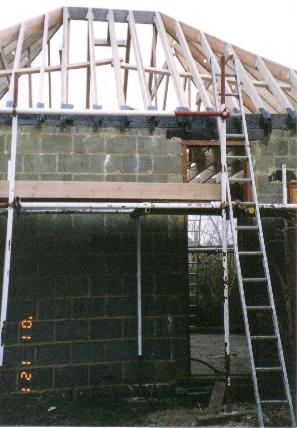
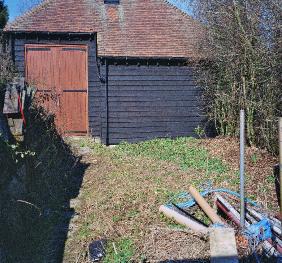
New GarageThe new garage separates the vegetable garden from the back garden. I dug the foundations for my new garage and put the topsoil in one section of the back garden, the concrete in a mound and the subsoil sand in 2 more mounds of the back garden in 2000. The concrete foundations and floor were installed by bricklayers. A bricklayer built the walls, the door manufacturers installed the doors and I then installed the:-
|
Site design and content copyright ©December 2006. Page structure amended October 2012. Text altered to Verdana 10 pt Blue December 2023 as is being done to the remainder of this website. Chris Garnons-Williams. DISCLAIMER: Links to external sites are provided as a courtesy to visitors. Ivydene Horticultural Services are not responsible for the content and/or quality of external web sites linked from this site.
|
|||
by myself. I bought second-hand scaffolding and boards. I erected the scaffolding inside the garage to install the wallplates and the joists. I created the following scaffolding plan so that all of my scaffolding could be installed outside the garage walls, so that I could install the rafters from it.
|
||||
I created the following plan to calculate the amount of ironmongery required for the installation of the joists:-
|
||||
I created the following plan to calculate the timber and ironmongery required for the roof structure using the book "Site Carpentry and Joinery" from the Practical Projects section of my Library:-
The Common Rafters were each 38mm x 150mm and were installed as a pair and then bolted together because there was too much weight for handling one piece of timber of 76mm x 150mm x 5000mm for those going over the log area. Dragon Beams were installed at each of the corners to prevent the hip ridges from sliding off the walls. All the timber used was stored on scaffolding above ground level with every piece separated from another and it was exposed to the weather for up to 5 months, whilst I constructed the roof between doing days of work for clients of Ivydene Horticultural Services. If the timber had been put together, then it could have warped, split and bent. The drain pipe taking the rainwater from the entire roof was installed in a trench alongside the vegetable garden hedge, surrounded by pea-shingle which itself was enveloped by Plantex. The end of the pipe closest to the soakaway had a rightangle bend put on it facing up so that the water would have to fill the pipe before it could overflow into the soakaway. Slits were cut in that pipe alongside the hedge at the halfway height position to allow the water to drain out to water the hedge. The drain pipe was laid with a 1 in 40 slope to guarantee that water would flow down it. |
||||
Garage Roof Structure
|
View from Vegetable Garden
|
|||
|
||||



Library Pages
|
The Garden Style chosen at the beginning defines what a garden should look like. Following this choice of Garden Style, then:-
Plant Association shows which plant combinations give pleasing flower or foliage colour combinations, then Plant Type gives growing conditions of a family of plants - ie Primulas - with lists of primulas with the same flower colour, foliage colour or height and where is suitable for those plants, followed by Plant Species gives data about a family of plants in a restricted format - ie without lists - as the lowest level of useful information (unless you are prepared to read the text in a whole book each time you want to use this particular species of plant).
Gardening gives general information on how to garden for the whole garden. Garden Cultivation gives specific information on veg, fruit, lawn, pond, etc. Garden Pests details garden pests/diseases and their control.
Practical Projects gives details on how to construct hard landscaping. |
THE 2 EUREKA EFFECT PAGES FOR UNDERSTANDING SOIL AND HOW PLANTS INTERACT WITH IT OUT OF 15,000:-
or
when I do not have my own or ones from mail-order nursery photos , then from March 2016, if you want to start from the uppermost design levels through to your choice of cultivated and wildflower plants to change your Plant Selection Process then use the following galleries:-
|
|
There are other pages on Plants which bloom in each month of the year in this website:-
|
|
|
|
|
|
Copied from |
Glossary F |
Glossary K |
Glossary P |
Glossary U |
Glossary B |
Glossary G |
Glossary L |
Glossary Q |
Glossary V |
Glossary C |
Glossary H |
Glossary M |
Glossary R |
Glossary W |
Glossary D |
Glossary I |
Glossary N |
Glossary S |
Glossary XYZ |
Glossary E |
Glossary J |
Glossary O |
Glossary T |
EU Directive No. 456179 |
Copied from |
Offbeat Glossary HILM |
Offbeat Glossary NO |
|
Offbeat Glossary A |
|
Offbeat Glossary B DuLally Bird |
Offbeat Glossary QRST |
Offbeat Glossary C |
|
Offbeat Glossary DE |
Offbeat Glossary V |
Offbeat Glossary F |
|
Offbeat Glossary G |
|
Ground Cover Herbs from Seed I often get asked what herbs are suited as ground covers. Customers tell me, "I hate cutting grass," or "I like trying something completely different, and I don't mind if my neighbours think I'm crazy to dig up my lawn." Herbal ground covers are very different, but their pleasing leaf textures and often showy masses of colour are becoming more popular in place of grass. Being the tough little critters they are, they need next to no care once established. And if you don't mind foliage and flowers that tickle your ankles and beyond, you can dispense with the weekly trysts with the lawnmower to keep things trim and proper. The biggest problem with herbal lawns is the start up cost. Regrettably, some of the finest low growing herbs are only increased by cuttings or division – the flowerless variety of english chamomile, Treneague, is a notable example. You need the payroll of a CEO to afford enough plants for an instant lawn. Or, you need the patience for many seasons of divide and spread to cover much ground starting with a few plants. Fortunately there are several good choices for herbs you can grow from seed. By far the most popular is wild thyme (Thymus praecox subsp. articus), also known as mother-of-thyme. It grows 4 to 6 inches high, has masses of rose-pink flowers in July, and grows fast enough to crowd out weeds. At 110,000 seeds per ounce, the seeds are very fine, much smaller than grass seeds, so it is a good idea to mix seeds with a filler like sand to avoid dropping 90% of your seed in 10% of the area to be covered. We recommend an ounce of seed per 1000 square feet. In the kitchen wild thyme is not commonly regarded as a culinary herb in North America, but European cooks have long used it in meat dishes just like the more famous English and French thymes (Thymus vulgaris). If nothing else, wild thyme will at least drive you from drink should you dare to consumer alcohol and the leaves at the same time. The combination causes a mother-of-a-hangover! Another popular choice for lawnless lawns is yarrow (Achillea millefolium). While its white, red or pink flowering stalks can reach a foot in height, its dense, many-divided leaves make for a cushion lawn that just invites a picnic, a snooze or other prostrate activities. I have seen yarrow used very successfully in small urban settings. especially under partial shade. If the flowers get too high, one or two runs a season with the lawnmower will keep things in check. Yarrow seeds are small and light, lighter than wild thyme. there are 175,000 seeds per ounce, and an ounce per 2500 square feet is the recommended sowing rate. Yarrow tea is insurance for colds and flus, which is a good thing if you are going to lie around in your lawn a lot. If you don't mind a more rangy and taller cover, Fassen's catnip (Nepeta x faassenii) is a good aromatic choice, growing up to 12 inches in height. Don't worry, cats are not as enamoured by this variety as they are by the much taller growing regular catnip (Nepeta cataria). Sow an ounce per 600 square feet. Roman chamomile (Chamaemelum nobile) is a good choice for warmer, sunny locales. It is a perennial, hardy to zone 6, with finely divided emerald leaves. The small daisy-like flowers are, of course, used to make the popular herbal tea. Be forewarned, there are those who insist that tea made from the Roman (sometimes also known as 'English') is superior to the annual German or Hungarian variety (Matricaria recutita), and there are others who argue just as strenuously the other way. As sides ten to fall along ethnic lines, we prefer to stay out of the debate! In any case, a Roman chamomile lawn is pure enchantment in many landscape settings. Again the seed are very fine – 155,000 per ounce – and one ounce will cover 2000 square feet. As with all seeds this small, it is crucial not to plant too deep; best simply to press the seeds, once broadcast, into the soil using a board or other object with a flat surface. |
|